If you’re a support provider and have been operating through Marketplace Platform Kynd, the recent announcement about closing in March 2026 may feel unsettling — especially if you relied on the platform for invoicing, payments, or visibility to find new clients.
The good news is: your work doesn’t need to stop.
You can continue supporting your clients as you have been — the change is simply how your admin, invoicing and insurance are managed.
Below are some clear next steps to help you move forward with confidence.
Step 1: Know that you can keep working as a sole trader
One of the strongest themes from the research? Red tape.
Nearly 1 in 2 workers say they’re overwhelmed by paperwork and blocked by administrative requirements.
For sole traders, this lands even harder. There’s no admin person or assistant. No payroll officer. No bookkeeper. It’s just… you.
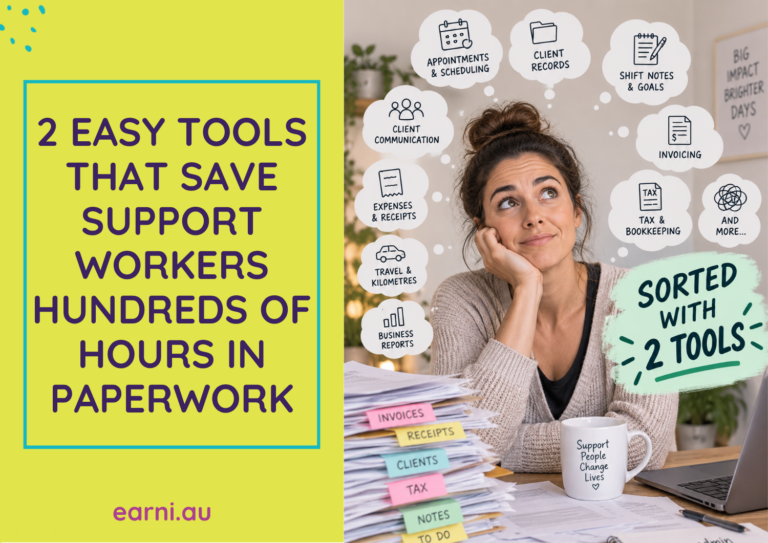
Service bookings, invoices, claims, emails, worker screening reminders, tax obligations, service agreements, NDIS requirements — it adds up quickly. And it’s eating into personal time, client time and recovery time (which everyone needs!). We recommend trying Earni for all admin work – it saves you time and stress, and gives you BACK your freedom.
If you were operating through Marketplace Platform Kynd:
- you can continue working as a sole trader under your own ABN, and organise your own insurance for your supports
- your existing clients don’t need to change, nor does your level of support
- support arrangements can continue as normal, just some of the admin processes may change a little
Step 2: Review your options
Some support workers may choose to:
- join another marketplace-style platform and continue to pay a % commission of your earnings
- move to a provider platform like Mable
- manage your client admin and invoicing independently using a dedicated tool to make it easier
There’s no single “right” choice — it depends on how much control, flexibility, and visibility you want for your business.
Step 3: Understand the difference between marketplaces and admin tools
Marketplaces often:
- sit between you and your clients
- take a percentage of your income ongoing
- control visibility and communication
Admin and bookkeeping tools work differently. They:
- support you to operate independently, so all your income is yours
- help you manage clients, invoices, payments, accounts, communication tax and expense management
- don’t replace your relationships with clients, they simply alleviate the admin stress, and do the fiddly work behind the scenes
This is where tools like Earni come in.
Step 4: Consider Earni as an alternative option – the business tool with it all
Earni isn’t a replacement for Kynd — it operates a little differently.
Earni app has been created to support independent support workers by helping with:
- your bookkeeping, accounts and admin
- creating, sending and tracking payment on invoices
- tracking income, expenses, and tax – you can even export a profit & loss statement
- managing client details, notes, appointments with automated communications
- getting paid faster, without losing a percentage of your earnings
- creating and storing files such as service agreements, all in one place
- increasing your visibility for new potential clients through the provider look-up
Using Earni as a tool, you can continue working under your own ABN with your own clients – that support relationship doesn’t need to change. Earni simply helps keep the business side organised, clear, and easy. It saves time and stress – by being organised, you feel lighter and on top of your business accounts.
Step 5: Set up the essentials
If you’re moving away from a marketplace model, you may need to:
- ensure you have the appropriate insurance in place (download our free sole trader support business guide HERE)
- clearly outline your services, service area and rates
- choose a system (like Earni app) to manage invoices, clients and payments
- keep expenses and records organised for tax and reporting
These are normal steps when operating independently — and many support workers are already doing this with ease. It gives you back your freedom and puts you in control of your support business.
Step 6: Stay visible to potential clients
If discovery was previously handled by a marketplace, it’s worth thinking about:
- how clients can find you
- how your services are shared and found
- how new enquiries can reach you
Earni app includes a provider look-up, allowing support workers to advertise their services for free on the premium version and stay visible to potential clients (over 5,000!) — without relying on a single platform.
Change can feel uncomfortable, especially when it’s unexpected. But many support workers find that moving toward independence gives them more clarity, more control, and fewer disruptions long-term.
If you’re looking for a steady way to manage admin, accounts, invoicing, payments and your client details and notes, so you can focus on doing the best support work you can, Earni is an option worth considering that could really help.