Skip to content

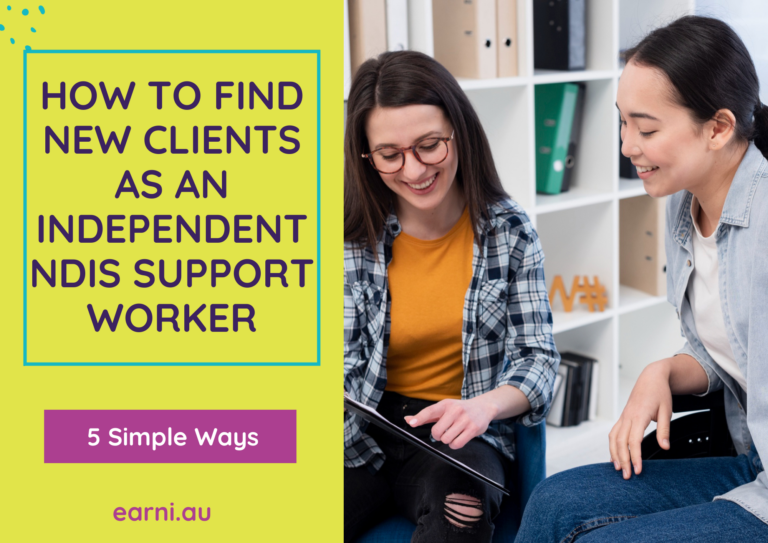
How do I get more disability support clients?

Read Time – 4mins

Need more disability support clients to fill your week, but unsure where to start?

If you’re a NDIS support worker or provider, one of the biggest challenges is finding new clients — and the right clients. Where do you look? You might already have a few regular disability support clients you love working with, but if you’re looking to grow your business or fill a few gaps in your week, it can feel hard to know where to start.

The good news? There are practical, affordable ways to get your name out there and connect with more people who need your services who could be a perfect fit for what you offer.

Need more disability support clients to fill your week, but unsure where to start?

1. Get listed on the Earni Provider Look-up

If you only try one thing, make it this one.

Earni’s Provider Look-up is designed specifically for NDIS support workers, coordinators, and providers to showcase their services directly to people looking for support. It’s simple, affordable, and highly effective — giving you visibility to more than 5,000 potential clients.

When you create your provider listing, you can:

  • Add a profile photo and short video to introduce yourself
  • Share details about your services, experience, and availability
  • Include your contact information so clients can reach you directly

It’s your own personalised connection page — a space where potential clients can see who you are and what you offer, helping you stand out and build trust before they even make contact.

For Earni premium members, your advert runs for 60 days and can be easily renewed. At just $27 per month, you also get access to Earni’s full suite of features to manage your business admin, clients, invoices, and expenses — everything you need to run your support business with ease. It’s much more affordable than many advertising options out there.

If you’re ready to grow your client base and attract more enquiries, this is one of the easiest ways to do it. Get Earni Here.

2. Network within your community

Word-of-mouth referrals are powerful in the NDIS space. Attend local community events, disability expos, or provider meetups. Introduce yourself to support coordinators and plan managers — many are always looking for reliable support workers to refer clients to. Jump into Facebook and LinkedIn groups too, as cross referring happens frequently in these groups.

Building genuine connections often leads to long-term, trusted client relationships.

3. Build a simple online presence

You don’t need a fancy website — a basic Facebook page or LinkedIn account can help potential clients find you. Post updates, share tips or stories from your work (while maintaining confidentiality), and highlight what makes your support unique.

Being visible online builds familiarity, and familiarity builds trust.

4. Keep your details up to date

Wherever your name appears — online listings, social pages, or directories — make sure your contact information, service area, and availability are current. It’s a simple step, but it ensures potential clients can easily reach you when they’re looking for support.

There are many ways you grow and get more disability support clients, but we hope these get you started for now. Growing can take time, but persistence pays off, so hang in there!

While you're here...take a look

How to Use the NDIS Price Guideline in Your Support Work Business

The NDIS Price Guideline can be overwhelming. Line items, pricing limits, travel rules, different support categories it’s a lot. So here's how to turn this manual, repetitive process into a faster...

NDIS Plan-Managed, Self-Managed, NDIA-Managed – What’s the Difference?

If you support people under the NDIS, you would have heard of plan-managed, self-managed, and NDIA-managed plan options. Understanding the difference is important for providers. Let's take a closer...

Using word docs for your NDIS invoices? Here’s a much simpler way

In 2026, is handwriting, or using PDFs or word docs for your NDIS invoices really the fastest and easiest way to get paid? Manual ways are moving out the door, and new efficient methods that save you...

I need a profit and loss statement for my NDIS support business, fast!

You may have heard the terminology, but felt it was a bit complex? The truth is, for sole traders and small NDIS providers, a profit and loss statement it’s actually very simple. Let's take a look at...

Do NDIS Support Workers Need a Marketplace Platform to Operate?

When marketplace platform Kynd recently announced it was closing, many sole trader NDIS Support Workers were left asking the same question: Do I need another platform to keep working with my clients?...

The Stress-Free Support Provider: Get Organised. Sort Your Business Accounts.

Running your own NDIS business can feel incredibly rewarding — but it can also feel overwhelming. Simple Shifts In Your Business Systems & Methods Can Transform You Into A Stress-Free Support Provider...

Marketplace Platform Kynd Closes Its Doors – What Do Support Workers Do?

If you’re a NDIS support provider and have been operating through Marketplace Platform Kynd, their recent announcement about closing may feel unsettling. Here are some clear next steps to help you...

Do I need to have a NDIS service agreement with my client?

If you’re a NDIS support worker or provider, you may have had the thought ‘do I actually need a service agreement with my client?’ Having a service agreement is strongly recommended and considered...

43% of Sole Trader NDIS Support Workers Feel Burned Out* — Here’s Why

43% of sole trader NDIS support workers feel burned out. The research has proven it. They're emotionally drained. We uncover why these facts have arisen, plus share our best tips for support workers...